On December 24, 1979, the
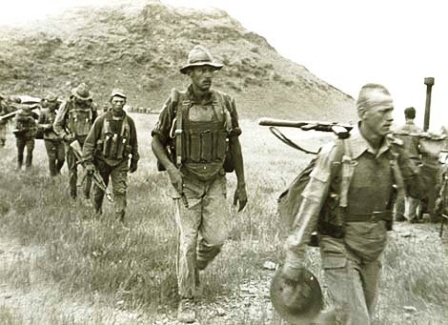
Soviet Union invades Afghanistan, under the pretext of upholding the Soviet-Afghan Friendship Treaty of 1978.

As midnight approached, the Soviets organized a massive military airlift into Kabul, involving an estimated 280 transport aircraft and three divisions of almost 8,500 men each. Within a few days, the Soviets had secured Kabul, deploying a special assault unit against Tajberg Palace. Elements of the Afghan army loyal to Hafizullah Amin put up a fierce, but brief resistance.

On December 27, Babrak Karmal, exiled leader of the Parcham faction of the Marxist People’s Democratic Party of Afghanistan (PDPA), was installed as Afghanistan’s new head of government. And Soviet ground forces entered Afghanistan from the north.

The Soviets, however, were met with fierce resistance when they ventured out of their strongholds into the countryside. Resistance fighters, called mujahidin, saw the Christian or atheist Soviets controlling Afghanistan as a defilement of Islam as well as of their traditional culture. Proclaiming a "jihad"(holy war), they gained the support of the Islamic world.
The mujahidin employed guerrilla tactics against the Soviets. They would attack or raid quickly, then disappear into the mountains, causing great destruction without pitched battles. The fighters used whatever weapons they could grab from the Soviets or were given by the
United States.

The tide of the war turned with the 1987 introduction of U.S. shoulder-launched anti-aircraft missiles. The Stingers allowed the mujahidin to shoot down Soviet planes and helicopters on a regular basis.
New Soviet leader
Mikhail Gorbachev decided it was time to get out. Demoralized and with no victory in sight, Soviet forces started withdrawing in 1988. The last Soviet soldier crossed back across the border on February 15, 1989.

It was the first Soviet military expedition beyond the Eastern bloc since
World War II and marked the end of a period of improving relations (known as détente) in the
Cold War. Subsequently, the SALT II arms treaty was shelved and the U.S. began to re-arm.
Fifteen thousand Soviet soldiers were killed.
The long-term impact of the invasion and subsequent war was profound. First, the Soviets never recovered from the public relations and financial losses, which significantly contributed to the fall of the Soviet empire in 1991. Secondly, the war created a breeding ground for
terrorism and the rise of
Osama bin Laden.


Also on This Day
- Lead Story
- Soviet tanks roll into Afghanistan, 1979
- American Revolution
- Benjamin Rush is born, 1745
- Automotive
- Richard Trevithick introduces his "Puffing Devil", 1801
- Civil War
- Bombardment of Fort Fisher begins, 1864
- Cold War
- McCarren-Walter Act goes into effect, 1952
- Crime
- Islamic terrorists hijack a French plane, 1994
- Disaster
- Volcanic eruption sweeps away train, 1953
- General Interest
- War of 1812 ends, 1814
- Fire ravages Library of Congress, 1851
- KKK founded, 1865
- Hollywood
- Woody Allen marries Soon-Yi Previn, 1997
- Literary
- Stephenie Meyer, best-selling author of vampire novels, is born, 1973
- Music
- "Every Rose Has Its Thorn" puts Poison atop the charts, 1988
- Old West
- Kit Carson born in Kentucky, 1809
- Presidential
- Fire destroys Jefferson library, 1851
- Coolidge lights first national Christmas tree, 1923
- Sports
- Curt Flood challenges MLB reserve clause, 1969
- Vietnam War
- Viet Cong bomb Brinks Hotel, 1964
- Bob Hope gives his last show in Vietnam, 1972
- World War I
- American soldier John Douglas writes home from post-armistice France, 1918
- World War II
- French Admiral Jean Darlan is assassinated, 1942

 Just after midnight on Christmas morning, the majority of German troops engaged in World War I cease firing their guns and artillery and commence to sing Christmas carols. At certain points along the eastern and western fronts, the soldiers of Russia, France, and Britain even heard brass bands joining the Germans in their joyous singing.
 At the first light of dawn, many of the German soldiers emerged from their trenches and approached the Allied lines across no-man's-land, calling out "Merry Christmas" in their enemies' native tongues. At first, the Allied soldiers feared it was a trick, but seeing the Germans unarmed they climbed out of their trenches and shook hands with the enemy soldiers. The men exchanged presents of cigarettes and plum puddings and sang carols and songs. There was even a documented case of soldiers from opposing sides playing a good-natured game of soccer.
 The so-called Christmas Truce of 1914 came only five months after the outbreak of war in Europe and was one of the last examples of the outdated notion of chivalry between enemies in warfare. In 1915, the bloody conflict of World War I erupted in all its technological fury, and the concept of another Christmas Truce became unthinkable.