Thursday, March 7, 2013

This Day in History: Mar 7, 1902: Battle of Tweebosch, South Africa


In the Battle of Tweebosch or De Klipdrift on 7 March 1902, a Boer commando led by Koos de la Rey defeated a British column under the command of Lieutenant General Lord Methuen during the final months of the Second Boer War.


Background
In order to trap the Boer guerrillas in the Orange Free State, Lord Kitchener built lines of blockhouses connected with barbed wire. But there was not enough water in the Western Transvaal to employ the blockhouse system. Instead, he unleashed nine columns to hunt down De la Rey and the other Boer commanders in the area. On 24 February 1902, De la Rey pounced on a wagon convoy commanded by Lieutenant Colonel S. B. Von Donop. For the loss of 51 Boers, De la Rey killed, wounded or captured 12 officers and 369 men.[2] In response, Methuen tried to track the Boer leader down.


Battle
Less than two weeks later, De la Rey ambushed Methuen's column at Tweebosch on the Little Harts River. The British force numbered 1250, including nearly 1000 mounted men and four guns. Methuen's force was largely made up of green troops; these panicked and fled or surrendered. Only the British regulars in the column fought stubbornly in the combat which lasted from dawn until 9:30 am. The British lost 200 killed and wounded, plus 600 men and all four guns captured. After being wounded twice and suffering a broken leg when his horse fell on him, Methuen was captured.[3] He was the only general taken prisoner by the Boers during the war.[2]


Source: galago.co.za via Juan on Pinterest


Aftermath

De la Rey sent the wounded Methuen to a British hospital in his own carriage under a flag of truce, despite demands from his own troops to execute him. The Boers court marshaled De la Rey for freeing such a valuable prisoner, but after convincing the court that Methuen would withdraw from the war, he was let off.

Source: oocities.org via Juan on Pinterest

Upon hearing news of the disaster, a badly shaken Kitchener retired to his bedroom for two days and refused to eat. Recovering his poise, he ordered heavy reinforcements sent to the Western Tranvaal and appointed Colonel Ian Hamilton to coordinate the British effort. On 11 April, one of Hamilton's columns beat the Boers at the Battle of Rooiwal.


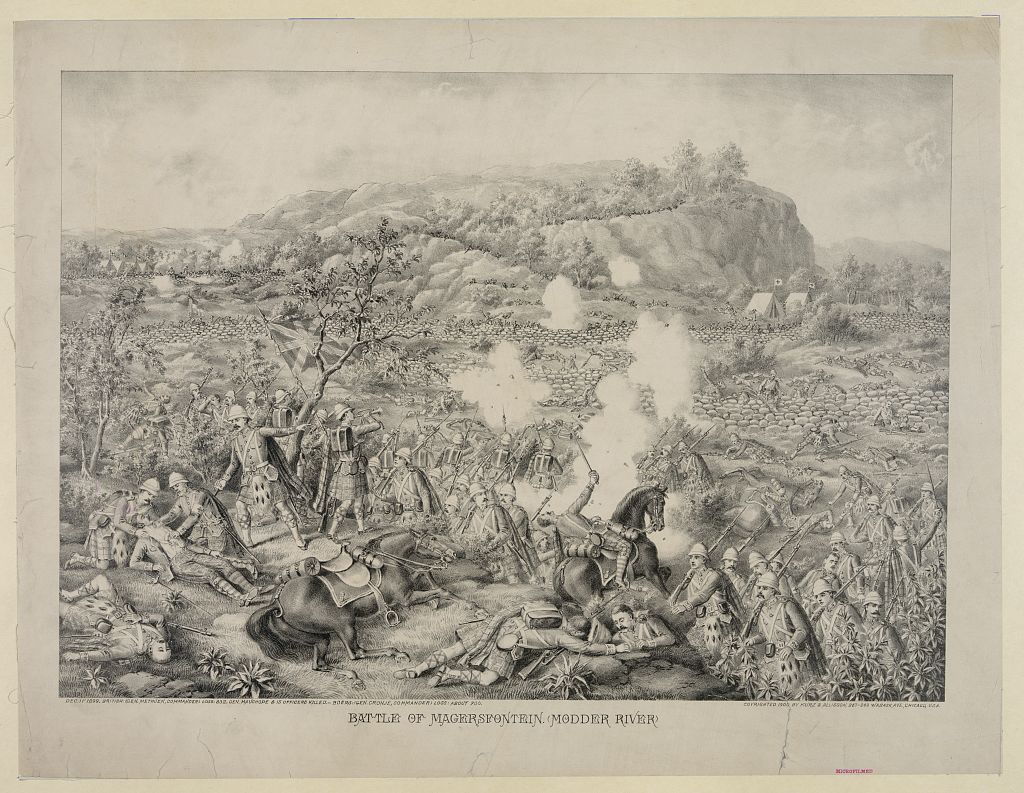
The defeat at Tweebosch, the biggest defeat for the British since the beginning of the war, had far-reaching consequences. In addition to the 68 killed, 121 wounded and 205 captured (including a general), 6 guns had also been taken and the biggest British force in the Western Transvaal neutralised. Questions were asked in parliament as to why Methuen had not been recalled following his defeat at Magersfontein.[1] On the Boer side, there was a feeling that an honourable end could be found to the war.


Metheun escaped with his career intact, with the War Office and Kitchener taking the brunt of criticism for providing him with green troops.[1] On 9 April, Boer and British delegations convened to discuss a negotiated surrender, which was signed on 31 May.

References


Footnotes


  1. ^ a b c Miller, p. 227
  2. ^ a b Pakenham, p 583
  3. ^ Evans, p 155
 Taken from: http://en.wikipedia.org/wiki/Battle_of_Tweebosch [07.03.2013]

Wednesday, March 6, 2013

This Day in History: Mar 6, 1475: Michelangelo born


Source: glbtq.com via Juan on Pinterest

Michelangelo Buonarroti, the greatest of the Italian Renaissance artists, is born in the small village of Caprese on March 6, 1475. The son of a government administrator, he grew up in Florence, a center of the early Renaissance movement, and became an artist's apprentice at age 13. Demonstrating obvious talent, he was taken under the wing of Lorenzo de' Medici, the ruler of the Florentine republic and a great patron of the arts. For two years beginning in 1490, he lived in the Medici palace, where he was a student of the sculptor Bertoldo di Giovanni and studied the Medici art collection, which included ancient Roman statuary.


With the expulsion of the Medici family from Florence in 1494, Michelangelo traveled to Bologna and Rome, where he was commissioned to do several works. His most important early work was the Pieta (1498), a sculpture based on a traditional type of devotional image that showed the body of Christ in the lap of the Virgin Mary. Demonstrating masterful technical skill, he extracted the two perfectly balanced figures of the Pieta from a single block of marble.


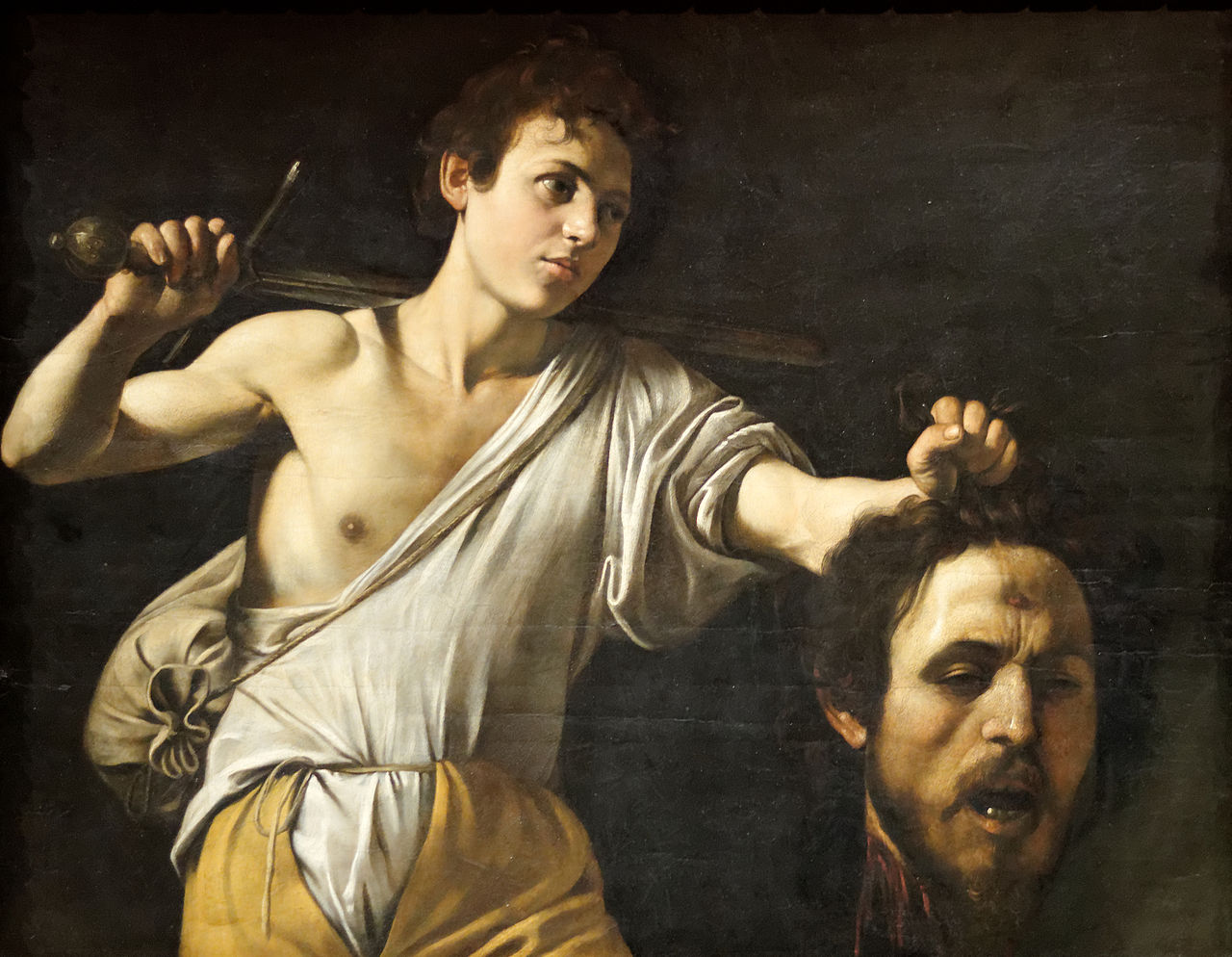
With the success of the Pieta, the artist was commissioned to sculpt a monumental statue of the biblical character David for the Florence cathedral. The 17-foot statue, produced in the classical style, demonstrates the artist's exhaustive knowledge of human anatomy and form. In the work, David is shown watching the approach of his foe Goliath, with every muscle tensed and a pose suggesting impending movement. Upon the completion of David in 1504, Michelangelo's reputation was firmly established.


That year, he agreed to paint a mural for the Florence city hall to rest alongside one being painted by Leonardo da Vinci, another leading Renaissance artist and an influence on Michelangelo. These murals, which depicted military scenes, have not survived. In 1505, he began work on a planned group of 12 marble apostles for the Florence cathedral but abandoned the project when he was commissioned to design and sculpt a massive tomb for Pope Julius II in Saint Peter's Basilica in Rome. There were to have been 40 sculptures made for the tomb, but the pope soon ran out of funds for the project, and Michelangelo left Rome.

Source: arttrav.com via Juan on Pinterest

Source: wga.hu via Juan on Pinterest

In 1508, he was called back to Rome to paint the ceiling of the Sistine Chapel--the chief consecrated space in the Vatican. Michelangelo's epic ceiling frescoes, which took several years to complete, are among his most memorable works. Central in a complex system of decoration featuring numerous figures are nine panels devoted to biblical world history. The most famous of these is The Creation of Adam, a painting in which the arms of God and Adam are outstretched toward each other.


In 1512, Michelangelo completed the Sistine Chapel ceiling and returned to his work on Pope Julius II's tomb. He eventually completed a total of just three statues for the tomb, which was eventually placed in the church of San Pietro in Vincoli. The most notable of the three is Moses (1513-15), a majestic statue made from a block of marble regarded as unmalleable by other sculptors. In Moses, as in David, Michelangelo infused the stone with a powerful sense of tension and movement.


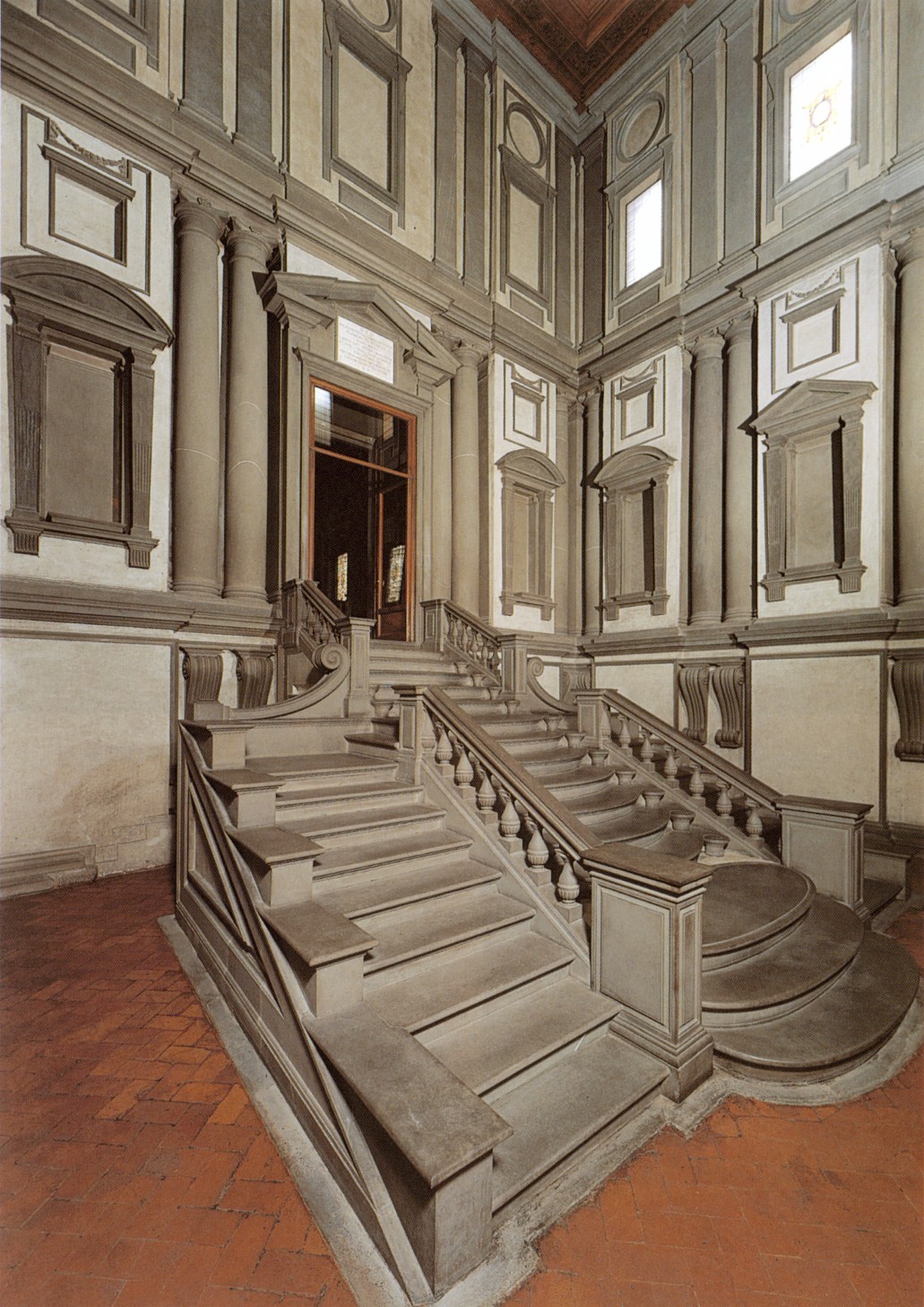
Having revolutionized European sculpture and painting, Michelangelo turned to architecture in the latter half of his life. His first major architectural achievement was the Medici chapel in the Church of San Lorenzo in Florence, built to house the tombs of the two young Medici family heirs who had recently died. The chapel, which he worked on until 1534, featured many innovative architectural forms based on classical models. The Laurentian Library, which he built as an annex to the same church, is notable for its stair-hall, known as the ricetto, which is regarded as the first instance of mannerism as an architectural style. Mannerism, a successor to the Renaissance artistic movement, subverted harmonious classical forms in favor of expressiveness.


In 1534, Michelangelo left Florence for the last time and traveled to Rome, where he would work and live for the rest of his life. That year saw his painting of the The Last Judgment on a wall above the altar in the Sistine Chapel for Pope Paul III. The massive painting depicts Christ's damnation of sinners and blessing of the virtuous, and is regarded as a masterpiece of early mannerism. During the last three decades of his life, Michelangelo lent his talents to the design of numerous monuments and buildings for Rome, which the pope and city leaders were determined to restore to the grandeur of its ancient past. The Capitoline Square and the dome of St. Peter's, designed by Michelangelo but not completed in his lifetime, remain two of Rome's most famous visual landmarks.


Michelangelo worked until his death in 1564 at the age of 88. In addition to his major artistic works, he produced numerous other sculptures, frescoes, architectural designs, and drawings, many of which are unfinished and some of which are lost. He was also an accomplished poet, and some 300 of his poems are preserved. In his lifetime, he was celebrated as Europe's greatest living artist, and today he is held up as one of the greatest artists of all time, as exalted in the visual arts as William Shakespeare is in literature or Ludwig van Beethoven is in music.


Taken from:  http://www.history.com/this-day-in-history/michelangelo-born [06.03.2013]

Tuesday, March 5, 2013

This Day in History: Mar 5, 1916: SA troops invade East Africa in World War I


Source: old-print.com via Juan on Pinterest

Britain had fought the Boer settlers in South Africa in the Anglo-Boer wars (1880-1, 1899-1902), so in 1914 many Afrikaaners sympathised with Germany. While Prime Minister, Botha was raising an expedition to invade German South West Africa, pro-German Boers raised a rebellion against British authority. This was not fully suppressed until early 1915 and only then could the invasion of South West Africa be fully launched. On 5 March 1916 South African Troops, led by General Jan Smuts, invaded East Africa in their confrontation with German forces.

Source: justdone.co.za via Juan on Pinterest


More than 146 000 Whites, 83 000 Blacks and 2 500 people of mixed race and Asians served in South African military units during the war, including 43,000 in German South-West Africa and 30 000 on the Western Front. An estimated 3,000 South Africans also joined the Royal Flying Corps. The total number of South African casualties during the war was approximately 7000 dead and 12 000 wounded by 1918.


South Africa greatly assisted the Allies, and Great Britain in particular, in capturing the two German colonies of German West Africa and German East Africa (although many South African troops were tied down by the failure to capture all the German East Africa forces) as well as in battles in Western Europe and the Middle East. South Africa's ports and harbors, such as at Cape Town, Durban, and Simon's Town, were also important rest-stops, refueling-stations, and served as strategic assets to the British Royal Navy during the war, helping to keep the vital sea lanes to the British Raj open.

Source: iwm.org.uk via Juan on Pinterest

Military action against Germany during World War I

The South African Union Defence Force saw action in a number areas:
  1. It dispatched its army to German South-West Africa, later known as South West Africa, and now known as Namibia. The South Africans expelled German forces and gained control of the former German colony. (See German South-West Africa in World War I.)
  2. A military expedition under General Jan Smuts was dispatched to German East Africa (later known as Tanganyika) and now known as Tanzania. The objective was to fight German forces in that colony and to try to capture the elusive German General von Lettow-Vorbeck. Ultimately, Lettow-Vorbeck fought his tiny force out of German East Africa into Mozambique then Northern Rhodesia, where he accepted a cease-fire three days after the end of the war (see East African Campaign (World War I)).
  3. 1st South African Brigade troops were shipped to France to fight on the Western Front. The most costly battle that the South African forces on the Western Front fought in was the Battle of Delville Wood in 1916. (See South African Army in World War I and South African Overseas Expeditionary Force.)
  4. South Africans also saw action with the Cape Corps as part of the Egyptian Expeditionary Force in Palestine. (See Cape Corps 1915–1991)


Source: ibiblio.org via Juan on Pinterest


References
  • (2003) Focus: Milestones, The Star, 5 March.
  • The First World War, combatant states, South Africa [online]. Available at: channel4.com  [accessed 27 February 2009] 
Taken from: http://www.sahistory.org.za/dated-event/sa-troops-invade-east-africa-their-confrontation-german-forces-world-war-i [05.03.2013]