Friday, March 8, 2013

This Day in History: Mar 8, 1977: International Women's Day proclaimed


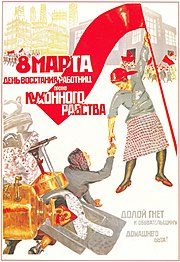
The first national Women's Day was observed on 28 February 1909 in the United States following a declaration by the Socialist Party of America.[2] In August 1910, an International Women's Conference was organized to precede the general meeting of the Socialist Second International in Copenhagen. Inspired in part by the American socialists, German Socialist Luise Zietz proposed the establishment of an annual 'International Woman's Day' (singular) and was seconded by communist Clara Zetkin, although no date was specified at that conference.[3][4] Delegates (100 women from 17 countries) agreed with the idea as a strategy to promote equal rights, including suffrage, for women.[5] The following year, on 18 March 1911, IWD was marked for the first time, by over a million people in Austria, Denmark, Germany and Switzerland. In the Austro-Hungarian Empire alone, there were 300 demonstrations.[3] In Vienna, women paraded on the Ringstrasse and carried banners honouring the martyrs of the Paris Commune.[3] Women demanded that women be given the right to vote and to hold public office. They also protested against employment sex discrimination.[1] Americans continued to celebrate National Women's Day on the last Sunday in February.[3]

Source: isis.aust.com via Juan on Pinterest


Source: nysut.org via Juan on Pinterest

In 1913 Russian women observed their first International Women's Day on the last Sunday in February (by Julian calendar then used in Russia). In 1917 demonstrations marking International Women's Day in Saint Petersburg on the last Sunday in February (which fell on 8 March on the Gregorian calendar) initiated the February Revolution.[1]


Following the October Revolution, the Bolshevik Alexandra Kollontai persuaded Vladimir Lenin to make it an official holiday in the Soviet Union, and it was established, but was a working day until 1965. On May 8, 1965 by the decree of the USSR Presidium of the Supreme Soviet International Women's Day was declared a non-working day in the USSR "in commemoration of the outstanding merits of Soviet women in communistic construction, in the defense of their Fatherland during the Great Patriotic War, in their heroism and selflessness at the front and in the rear, and also marking the great contribution of women to strengthening friendship between peoples, and the struggle for peace. But still, women's day must be celebrated as are other holidays."[citation needed]


From its official adoption in Russia following the Soviet Revolution in 1917 the holiday was predominantly celebrated in communist and socialist countries. It was celebrated by the communists in China from 1922, and by Spanish communists from 1936.[6] After the founding of the People's Republic of China on October 1, 1949 the state council proclaimed on December 23 that March 8 would be made an official holiday with women in China given a half-day off[7], though today's young women in college or before motherhood are increasingly reluctant to celebrate it for the suggestion of the term 'women' of youth ended, prettiness lost, and relational liberty restricted.


In the West, International Women's Day was first observed as a popular event after 1977 when the United Nations General Assembly invited member states to proclaim March 8 as the UN Day for women's rights and world peace.[8]


 References:
  1. ^ a b c "UN WomenWatch: International Women's Day - History". UN.org. Retrieved 2013-02-21.
  2. ^ "United Nations page on the background of the IWD". Un.org. Retrieved 2012-03-08.
  3. ^ a b c d Temma Kaplan, "On the Socialist Origins of International Women's Day", Feminist Studies, 11/1 (Spring, 1985)
  4. ^ "History of International Women's Day". United Nations. Retrieved 26 May 2012.
  5. ^ About International Women's Day
  6. ^ Nelson, Jinty. "International Women’s Day: a centenary to celebrate". History Workshop Online. Retrieved 28 August 2011.
  7. ^ "Anniversaries of important events". China Factfile. Chinese Government. Retrieved 28 August 2011.
  8. ^ "WomenWatch: International Women's Day". Un.org. Retrieved 2012-03-08.

Taken from: http://en.wikipedia.org/wiki/International_Women%27s_Day [08.03.2013]

This Day in History: Mar 8, 1917: February Revolution begins


In Russia, the February Revolution (known as such because of Russia's use of the Julian calendar) begins when riots and strikes over the scarcity of food erupt in Petrograd. One week later, centuries of czarist rule in Russia ended with the abdication of Nicholas II, and Russia took a dramatic step closer toward communist revolution.


By 1917, most Russians had lost faith in the leadership ability of the czarist regime. Government corruption was rampant, the Russian economy remained backward, and Nicholas repeatedly dissolved the Duma, the Russian parliament established after the Revolution of 1905, when it opposed his will. However, the immediate cause of the February Revolution--the first phase of the Russian Revolution of 1917--was Russia's disastrous involvement in World War I. Militarily, imperial Russia was no match for industrialized Germany, and Russian casualties were greater than those sustained by any nation in any previous war. Meanwhile, the economy was hopelessly disrupted by the costly war effort, and moderates joined Russian radical elements in calling for the overthrow of the czar.


On March 8, 1917, demonstrators clamoring for bread took to the streets in the Russian capital of Petrograd (now known as St. Petersburg). Supported by 90,000 men and women on strike, the protesters clashed with police but refused to leave the streets. On March 10, the strike spread among all of Petrograd's workers, and irate mobs of workers destroyed police stations. Several factories elected deputies to the Petrograd Soviet, or "council," of workers' committees, following the model devised during the Revolution of 1905.


On March 11, the troops of the Petrograd army garrison were called out to quell the uprising. In some encounters, regiments opened fire, killing demonstrators, but the protesters kept to the streets, and the troops began to waver. That day, Nicholas again dissolved the Duma. On March 12, the revolution triumphed when regiment after regiment of the Petrograd garrison defected to the cause of the demonstrators. The soldiers, some 150,000 men, subsequently formed committees that elected deputies to the Petrograd Soviet.

Source: cdn.dipity.com via Juan on Pinterest

Source: warbard.ca via Juan on Pinterest

The imperial government was forced to resign, and the Duma formed a provisional government that peacefully vied with the Petrograd Soviet for control of the revolution. On March 14, the Petrograd Soviet issued "Order No. 1," which instructed Russian soldiers and sailors to obey only those orders that did not conflict with the directives of the Soviet. The next day, March 15, Czar Nicholas II abdicated the throne in favor of his brother Michael, whose refusal of the crown brought an end to the czarist autocracy.

Source: libcom.org via Juan on Pinterest


The new provincial government, tolerated by the Petrograd Soviet, hoped to salvage the Russian war effort while ending the food shortage and many other domestic crises. It would prove a daunting task. Meanwhile, Vladimir Lenin, leader of the Bolshevik revolutionary party, left his exile in Switzerland and crossed German enemy lines to return home and take control of the Russian Revolution.


taken from: http://www.history.com/this-day-in-history/february-revolution-begins [08.03.2013]

Thursday, March 7, 2013

This Day in History: Mar 7, 1876: Alexander Graham Bell patents the telephone


On this day in 1876, 29-year-old Alexander Graham Bell receives a patent for his revolutionary new invention--the telephone.

The Scottish-born Bell worked in London with his father, Melville Bell, who developed Visible Speech, a written system used to teach speaking to the deaf. In the 1870s, the Bells moved to Boston, Massachusetts, where the younger Bell found work as a teacher at the Pemberton Avenue School for the Deaf. He later married one of his students, Mabel Hubbard.
While in Boston, Bell became very interested in the possibility of transmitting speech over wires. Samuel F.B. Morse's invention of the telegraph in 1843 had made nearly instantaneous communication possible between two distant points. The drawback of the telegraph, however, was that it still required hand-delivery of messages between telegraph stations and recipients, and only one message could be transmitted at a time. Bell wanted to improve on this by creating a "harmonic telegraph," a device that combined aspects of the telegraph and record player to allow individuals to speak to each other from a distance.

With the help of Thomas A. Watson, a Boston machine shop employee, Bell developed a prototype. In this first telephone, sound waves caused an electric current to vary in intensity and frequency, causing a thin, soft iron plate--called the diaphragm--to vibrate. These vibrations were transferred magnetically to another wire connected to a diaphragm in another, distant instrument. When that diaphragm vibrated, the original sound would be replicated in the ear of the receiving instrument. Three days after filing the patent, the telephone carried its first intelligible message--the famous "Mr. Watson, come here, I need you"--from Bell to his assistant.

Bell's patent filing beat a similar claim by Elisha Gray by only two hours. Not wanting to be shut out of the communications market, Western Union Telegraph Company employed Gray and fellow inventor Thomas A. Edison to develop their own telephone technology. Bell sued, and the case went all the way to the U.S. Supreme Court, which upheld Bell's patent rights. In the years to come, the Bell Company withstood repeated legal challenges to emerge as the massive American Telephone and Telegraph (AT&T) and form the foundation of the modern telecommunications industry.


Source: memory.loc.gov via Juan on Pinterest