Tuesday, December 6, 2016

This Day in History: DECEMBER 06, 1884 : WASHINGTON MONUMENT COMPLETED


On this day in 1884, in Washington, D.C., workers place a nine-inch aluminum pyramid atop a tower of white marble, completing the construction of an impressive monument to the city’s namesake and the nation’s first president, George Washington. As early as 1783, the infant U.S. Congress decided that a statue of George Washington, the great Revolutionary War general, should be placed near the site of the new Congressional building, wherever it might be. After then-President Washington asked him to lay out a new federal capital on the Potomac River in 1791, architect Pierre L’Enfant left a place for the statue at the western end of the sweeping National Mall (near the monument’s present location).


It wasn’t until 1832, however–33 years after Washington’s death–that anyone really did anything about the monument. That year, a private Washington National Monument Society was formed. After holding a design competition and choosing an elaborate Greek temple-like design by architect Robert Mills, the society began a fundraising drive to raise money for the statue’s construction. These efforts–including appeals to the nation’s schoolchildren–raised some $230,000, far short of the $1 million needed. Construction began anyway, on July 4, 1848, as representatives of the society laid the cornerstone of the monument: a 24,500-pound block of pure white marble.


Six years later, with funds running low, construction was halted. Around the time the Civil War began in 1861, author Mark Twain described the unfinished monument as looking like a “hollow, oversized chimney.” No further progress was made until 1876–the centennial of American independence–when President Ulysses S. Grant authorized construction to be completed.


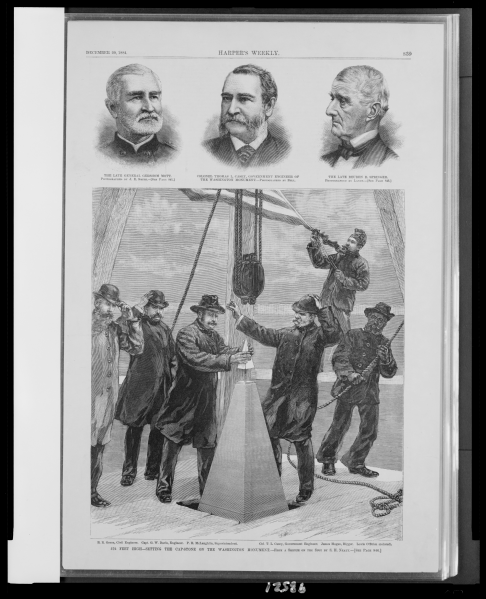


Made of some 36,000 blocks of marble and granite stacked 555 feet in the air, the monument was the tallest structure in the world at the time of its completion in December 1884. In the six months following the dedication ceremony, over 10,000 people climbed the nearly 900 steps to the top of the Washington Monument. Today, an elevator makes the trip far easier, and more than 800,000 people visit the monument each year. A city law passed in 1910 restricted the height of new buildings to ensure that the monument will remain the tallest structure in Washington, D.C.–a fitting tribute to the man known as the “Father of His Country.”


Article Details:

December 06, 1884 : Washington Monument completed

  • Author

    History.com Staff
  • Website Name

    History.com
  • Year Published

    2009
  • Title

    December 06, 1884 : Washington Monument completed
  • URL

    http://www.history.com/this-day-in-history/washington-monument-completed
  • Access Date

    December 06, 2016
  • Publisher

    A+E Networks

Monday, December 5, 2016

This Day in History: DECEMBER 05, 1945 : AIRCRAFT SQUADRON LOST IN THE BERMUDA TRIANGLE


At 2:10 p.m., five U.S. Navy Avenger torpedo-bombers comprising Flight 19 take off from the Ft. Lauderdale Naval Air Station in Florida on a routine three-hour training mission. Flight 19 was scheduled to take them due east for 120 miles, north for 73 miles, and then back over a final 120-mile leg that would return them to the naval base. They never returned.


Two hours after the flight began, the leader of the squadron, who had been flying in the area for more than six months, reported that his compass and back-up compass had failed and that his position was unknown. The other planes experienced similar instrument malfunctions. Radio facilities on land were contacted to find the location of the lost squadron, but none were successful. After two more hours of confused messages from the fliers, a distorted radio transmission from the squadron leader was heard at 6:20 p.m., apparently calling for his men to prepare to ditch their aircraft simultaneously because of lack of fuel.


By this time, several land radar stations finally determined that Flight 19 was somewhere north of the Bahamas and east of the Florida coast, and at 7:27 p.m. a search and rescue Mariner aircraft took off with a 13-man crew. Three minutes later, the Mariner aircraft radioed to its home base that its mission was underway. The Mariner was never heard from again. Later, there was a report from a tanker cruising off the coast of Florida of a visible explosion seen at 7:50 p.m.


The disappearance of the 14 men of Flight 19 and the 13 men of the Mariner led to one of the largest air and seas searches to that date, and hundreds of ships and aircraft combed thousands of square miles of the Atlantic Ocean, the Gulf of Mexico, and remote locations within the interior of Florida. No trace of the bodies or aircraft was ever found.


Although naval officials maintained that the remains of the six aircraft and 27 men were not found because stormy weather destroyed the evidence, the story of the “Lost Squadron” helped cement the legend of the Bermuda Triangle, an area of the Atlantic Ocean where ships and aircraft are said to disappear without a trace. The Bermuda Triangle is said to stretch from the southern U.S. coast across to Bermuda and down to the Atlantic coast of Cuba and Santo Domingo.


Flight 19's scheduled navigation exercise on December 5, 1945.
1. Leave NAS Fort Lauderdale 14:10 on heading 091°, drop bombs at Hen and Chickens shoals (B) until about 15:00 then continue on heading 091° for 73 nautical miles (140 km)
2. Turn left to heading 346° and fly 73 nautical miles (140 km).
3. Turn left to heading 241° for 120 nautical miles (220 km) to end exercise north of NAS Fort Lauderdale.
4. 17:50 radio triangulation establishes flight's position to within 50 nautical miles (93 km) of 29°N 79°W and their last reported course, 270°.
5. PBM Mariner leaves NAS Banana River 19:27.
6. 19:50 Mariner explodes near 28°N 80°W.
Article Details:

December 05, 1945 : Aircraft squadron lost in the Bermuda Triangle

  • Author

    History.com Staff
  • Website Name

    History.com
  • Year Published

    2009
  • Title

    December 05, 1945 : Aircraft squadron lost in the Bermuda Triangle
  • URL

    http://www.history.com/this-day-in-history/aircraft-squadron-lost-in-the-bermuda-triangle
  • Access Date

    December 05, 2016
  • Publisher

    A+E Networks
SaveSave

Friday, December 2, 2016

This Day in Crime History: DECEMBER 02, 1991 : KENNEDY COUSIN RAPE TRIAL BEGINS


Opening testimony takes place in the highly publicized rape trial of William Kennedy Smith, a nephew of President John F. Kennedy and son of Jean Kennedy Smith, the president’s sister and a former ambassador to Ireland. Smith, then a 30-year-old medical student at Georgetown University, was accused of sexually assaulting a 29-year-old Florida woman in the early hours of March 30, 1991, at the Kennedy family’s Palm Beach compound.


On the night of March 29, Smith went out in Palm Beach with his uncle, Senator Ted Kennedy, and cousin, Patrick Kennedy. They ended up at a night spot called Au Bar, where Smith met the accuser, who later accompanied him back to the Kennedy estate. Smith and the woman went for a walk on the beach, during which time Smith allegedly tackled and raped her. Taking the stand in his own defense in court, Smith testified he had sex with the woman but that it was consensual. At the trial, Judge Mary E. Lupo barred prosecutors from presenting testimony from three other women who claimed Smith had assaulted them.


As a member of one of America’s most famous families, Smith became the subject of intense public scrutiny and his trial turned into a media circus. Millions of viewers watched the nationally televised event and reporters from around the globe converged on the West Palm Beach courthouse. On December 11, after deliberating for 77 minutes, the six-member jury acquitted Smith on all charges. (In an interesting side note, Smith’s lead defense attorney, Roy Black, later married Lisa Haller, one of the jurors, in 1995.)


During the live television coverage of the trial, the accuser’s identity was electronically obscured with a large dot to protect her privacy. However, following the trial, the woman, Patricia Bowman, chose to identify herself publicly.


William Kennedy Smith became a doctor after the trial, specializing in working with victims of land mines, and remained largely out of the national spotlight. In 2004, a Chicago woman who was Smith’s assistant at the nonprofit Center for International Rehabilitation filed a lawsuit accusing him of sexual assault. A judge subsequently dismissed the suit.

Article Details:

December 02, 1991 : Kennedy cousin rape trial begins

  • Author

    History.com Staff
  • Website Name

    History.com
  • Year Published

    2009
  • Title

    December 02, 1991 : Kennedy cousin rape trial begins
  • URL

    http://www.history.com/this-day-in-history/kennedy-cousin-rape-trial-begins
  • Access Date

    December 02, 2016
  • Publisher

    A+E Networks